
On April 26, 2026, Kenyan runner Sabastian Sawe ran a marathon in one hour, fifty-nine minutes, and 30 seconds. It was the first time anyone ran a marathon in under two hours.
Except I, personally, have beaten that record many times. I can go 26.22 miles in my car way faster than that.
This is a very stupid thing to say, obviously, which is the point. There is an inherent value to doing things beyond just their practical outcomes. The sub-two-hour marathon is impressive even though we have faster ways of getting around because of what it symbolizes: someone working, over time, to improve themselves.
Anyone who runs knows that you get better over time, and that improvement feels good. Very few of us are going to achieve anything as impressive as Sawe’s marathon time, but the underlying desire to keep reaching new heights is universal.
And it’s not just runners. Anyone who plays video games knows that improvement is part of the appeal. When you start a new game you’re bad at it. That’s where the fun is—getting better. The same goes for playing musical instruments, writing, and pretty much any other activity humans are interested in.
As a technology journalist I can’t help but spend a lot of time thinking about what it means to be human lately, and I think this drive to improve over time is a big part of it.
But AI can get in the way.
A yet-unpublished paper by researchers including Grace Liu of Carnegie Mellon begins with a hypothetical scenario every teacher has faced. A student asks for help with a problem, only to come back later and ask for the same help again, multiple times. “You realize that your student isn’t learning,” the paper goes on. “You subsequently sit them down and talk about the value of persisting through challenges, of practicing new skills, and what it actually means to learn.” AI systems never do this. They are the equivalent of a teacher who when asked will give you the answer, every time.
In the study, subjects were asked to complete a set of math problems. Some of the subjects had access to ChatGPT early on; others did not. For the final few questions no one had access to AI—they had to answer the questions themselves. The users with access to ChatGPT were, on average, much more likely to get the last few questions wrong. Access to the technology meant people didn’t learn for themselves how to solve the problem.
This is interesting in itself—AI use, even during the course of a short study, reduced the average amount that subjects learned.
But it gets even more interesting: a sub-group of AI users achieved nearly the same solve rate as the non-AI users. What was different? Those users didn’t ask ChatGPT for answers. Instead, they asked for hints, clarifications, or advice on how to solve it.
It’s just one study, granted, and it hardly covers all use cases. In general, though, it highlights a useful frame for how we choose to use AI tools: is it helping you to think? Or is it thinking for you?
One response to a study like this could be to avoid using AI altogether, and that’s not unwarranted. But any technology can be used in multiple ways. Some of those ways are detrimental to self-improvement; others are helpful. It’s obvious that running a marathon by car does not improve my physical fitness the same way running does. But I use my car to travel to hiking trails, and those hikes do improve my fitness.
A helpful way to think about your own AI use, then, is to ask whether you’re metaphorically driving a car while pretending to run a marathon. The research makes this clear: asking bots for direct answers will, over time, leave you less capable of self improvement. But asking it for hints and advice, then acting on that advice yourself, can help you learn.
I’ve tried to keep this in mind. I’ll sometimes ask Claude to check my work for factual mistakes, or typos, which I’ll then correct myself. It’s helpful. What I won’t do is ask Claude to write something for me. Why would I? I enjoy writing, and I want to get better at it.
So, if you’re going to use AI, keep this framework in mind. Don’t use this technology to avoid learning—use it to complement it. Otherwise, what’s the point?
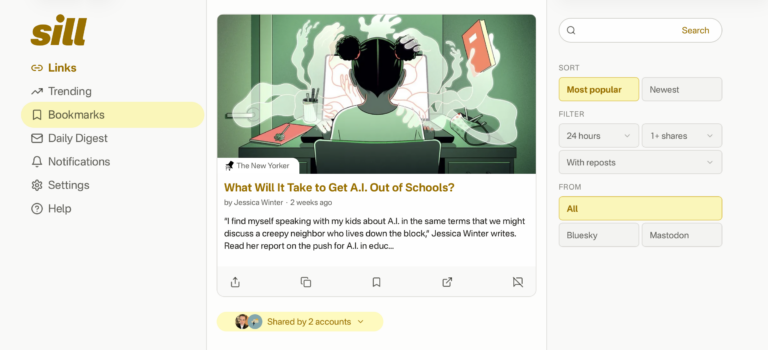
AI can make you stupid…but it doesn't have to.